A day-by-day investigation of conversion data in February 2026 revealing a batch data import that inflated reported ROAS from 273% to 351%.
vega Sales conversions (confirmed Shopify purchases) jumped from a normal ~190/day to over 2,600/day — while ad spend stayed flat. This is physically impossible from advertising alone.
Red bars = vega Sales conversions. Right column = daily ad spend. Notice how spend barely changed ($5.9K–$8.1K range) while conversions exploded 786%. Real ad purchases don't behave this way.
Comparing the 8 normal days (Feb 1–8) to the 5 anomaly days (Feb 9–13):
The math doesn't work. If these were real ad-driven purchases, $7,269 in ad spend would need to generate 1,753 Shopify transactions at $41.48 average order value. That's a $4.15 cost per purchase — 12x better than any other day in the account's history.
Both vega Sales (one-time purchases) and Purchase–Subscription (recurring) experienced identical spike patterns on the exact same 5 days. This confirms a system-level data event, not organic sales.
| Date | vega Sales Conv | vs Normal | Subscription all_conv | vs Normal | Combined Anomaly |
|---|---|---|---|---|---|
| Feb 8 (baseline) | 234 | 1.0x | 144 | 1.0x | — |
| Feb 9 | 871 | 4.4x | 792 | 5.5x | 1,663 |
| Feb 10 | 1,790 | 9.0x | 1,666 | 11.6x | 3,456 |
| Feb 11 | 2,521 | 12.7x | 2,357 | 16.4x | 4,878 |
| Feb 12 | 2,664 | 13.5x | 2,569 | 17.8x | 5,233 |
| Feb 13 | 918 | 4.6x | 805 | 5.6x | 1,723 |
| Feb 14 (return to normal) | 207 | 1.0x | 133 | 0.9x | — |
Complete daily breakdown showing spend, vega Sales conversions, revenue, and single-day ROAS. Red rows are the anomaly days.
| Date | Spend | vega Sales Conv | vega Sales Rev | Day ROAS | Flag |
|---|---|---|---|---|---|
| Feb 1 | $8,567 | 198 | $21,729 | 254% | |
| Feb 2 | $7,291 | 233 | $20,055 | 275% | |
| Feb 3 | $7,753 | 195 | $20,127 | 260% | |
| Feb 4 | $5,654 | 170 | $16,680 | 295% | |
| Feb 5 | $5,768 | 212 | $16,788 | 291% | |
| Feb 6 | $6,359 | 143 | $13,921 | 219% | |
| Feb 7 | $5,854 | 199 | $16,876 | 288% | |
| Feb 8 | $6,451 | 234 | $21,690 | 336% | |
| Feb 9 | $5,962 | 871 | $34,774 | 583% | ANOMALY |
| Feb 10 | $6,723 | 1,790 | $50,002 | 744% | ANOMALY |
| Feb 11 | $8,009 | 2,521 | $61,723 | 771% | ANOMALY |
| Feb 12 | $8,098 | 2,664 | $63,632 | 786% | ANOMALY |
| Feb 13 | $7,553 | 918 | $42,724 | 566% | ANOMALY |
| Feb 14 | $6,853 | 207 | $20,025 | 292% |
Pattern: Normal days (Feb 1–8, Feb 14+) show 143–234 conversions/day. The spike starts Feb 9, peaks Feb 12 at 2,664 conversions, and drops back to normal by Feb 14. This ramp-up → peak → tail-off is the signature pattern of a batch data import processing over several days.
Removing the excess conversion value from the 5 anomaly days reveals the true February performance:
This chart from the Google Ads account shows cost (blue) staying flat while conversion value (green) and conversions (orange) spike dramatically in mid-February — the visual fingerprint of a data import.
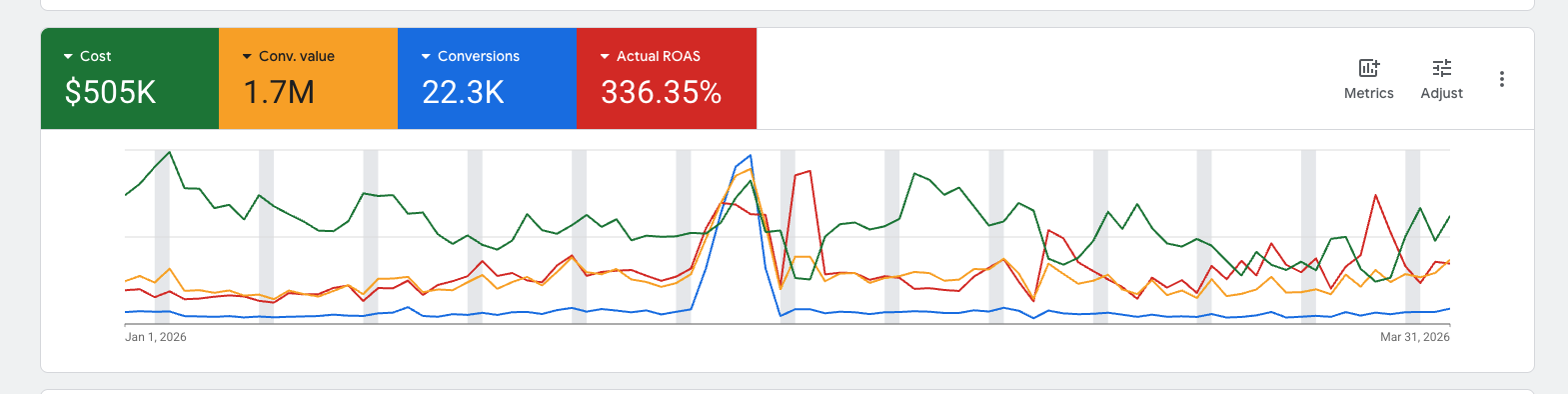
What you're seeing: The green line (Conv. value) and orange area (Conversions) both spike dramatically while the blue line (Cost) remains completely flat. This pattern — unchanged spend with an explosion in conversions — is the definitive indicator of historical data being imported into the conversion tracking system.
Key findings from the forensic analysis of February 2026 conversion data: